UK NFL Bet Types: Moneyline, Spread, and Prop Markets
 Available in US
The first time I watched a British punter freeze at a UK sportsbook NFL menu, it wasn’t because he didn’t understand American football. He knew the teams, followed the stats, could name every starter on the Chiefs. The problem was the betting interface. Moneyline? Handicap -6.5? ATS? He’d been watching the sport for two years and still felt like a tourist at the betting window.
That experience is more common than you’d think. NFL betting in the UK sits at the crossroads of two different betting cultures. UK punters are trained on fractional odds, match result markets, and accumulators built around football. American football betting, by contrast, grew up around the point spread — a market that barely exists in European football and that changes everything about how you approach a game.
In 2026, the NFL’s British fanbase has grown to an estimated 14.3 million people, according to NFL Research — nearly one in five residents of this country. A huge proportion of them want to bet but aren’t sure where to start with the market structure. This guide fixes that. I’m going to take every major NFL bet type available at UK sportsbooks and explain exactly how it works, when it creates value, and what the mechanics look like in practice. No US gambling jargon left unexplained. No hand-waving about concepts that actually matter to your bottom line. For the most comprehensive odds and expert analysis, always consult the top UK NFL betting guide before placing your wagers.
- UK NFL Moneyline Betting: Backing Outright Winners
- NFL Spread and Handicap Betting: What the Line Actually Means
- Over/Under Betting on NFL Games
- Player Props: Betting on Individual NFL Performances
- Same-Game Parlays and Bet Builders for NFL in the UK
- NFL Accumulators: Stacking Multiple Games for Bigger Returns
- NFL Futures and Outright Betting: Super Bowl and Beyond
- Frequently Asked Questions
UK NFL Moneyline Betting: Backing Outright Winners
If you’ve ever bet on a football match result , whether backing home, away or draw, you already understand the basic concept behind the moneyline. The difference with NFL is that there’s no draw. Every game ends with a winner, even if you have to sit through overtime to get there. That simplicity makes moneyline the most accessible NFL market for UK punters coming in fresh.
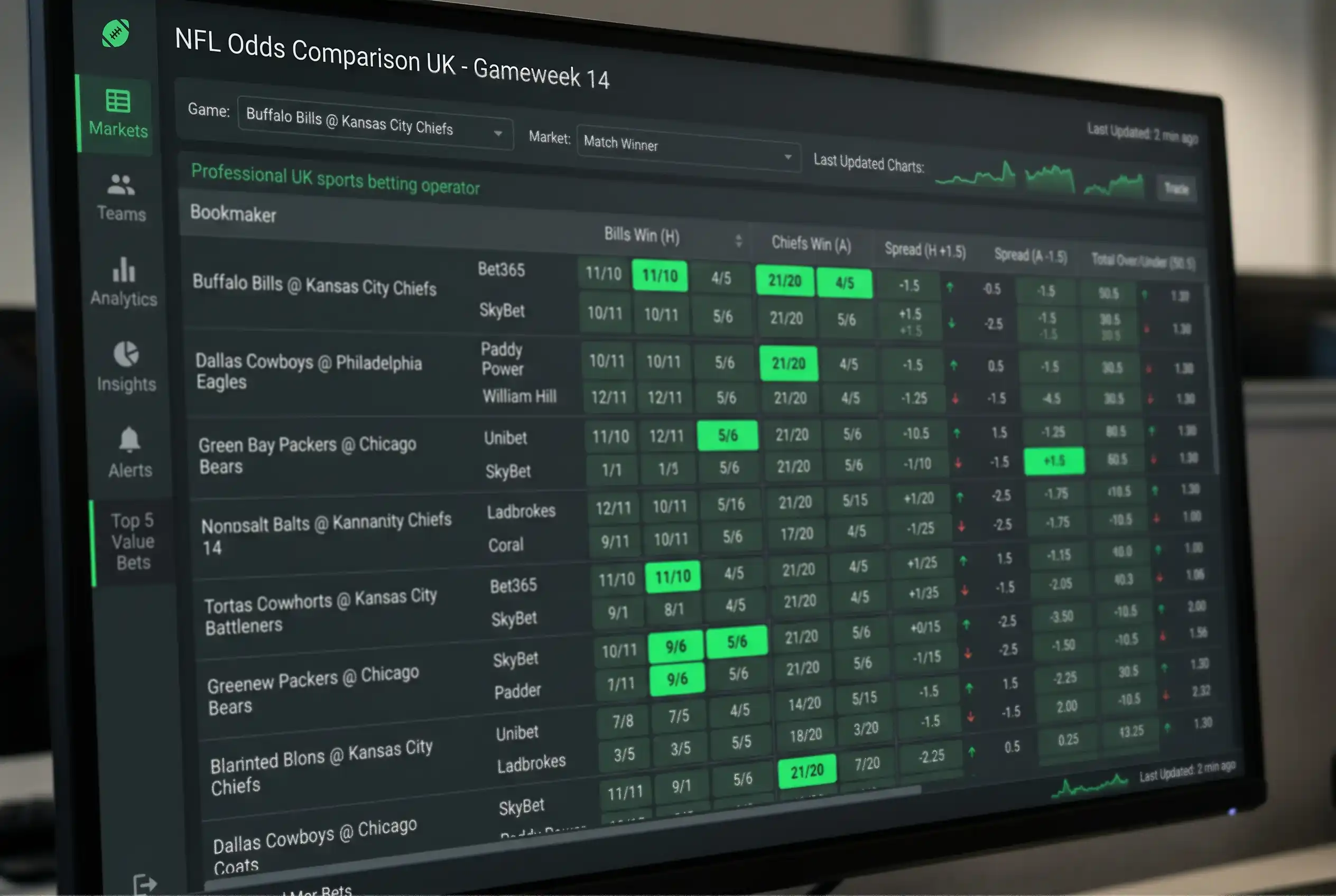
At UK sportsbooks, the moneyline is almost always displayed in decimal odds. You pick the team you think will win, and if they do, you collect. The complication arises with how the odds are structured. In a competitive game between two roughly equal sides, both teams might be priced around 1.87 to 1.91. The gap between those numbers is the bookmaker’s margin, built into both sides. In a lopsided fixture where a strong favourite faces a weaker opponent, you might see the favourite priced at 1.22 and the underdog at 5.00 or longer. That’s where most new punters make their first mistake: backing the heavy favourite on the moneyline and wondering why it barely moves the needle on their balance.
Here’s the honest truth about moneyline favourites in the NFL: they win a lot. Over the 2024 season, favourites won outright more than 71% of the time — one of the highest rates recorded in the modern era, according to industry betting trend analysis. That sounds like free money until you realise the odds already price in that dominance. Backing a 1.22 favourite repeatedly will drain your bankroll when the upset eventually lands, because the returns on the wins don’t compensate for the losses.
Where the moneyline genuinely earns its place is when you want clean exposure to a team without the noise of the spread. If you think a side is going to dominate completely (comfortably covering any handicap), the moneyline on the favourite at reduced odds still makes sense. And if you’ve done your homework on a live underdog that the market has mispriced — perhaps an injury to the opposing quarterback hasn’t been fully reflected in the odds — the underdog moneyline offers uncompromised upside.
One technical point worth understanding: at UK sportsbooks, moneyline bets settle on the final result including overtime. If a game is tied at the end of regulation and your team wins in OT, you win the bet. Some punters get confused by this because they’ve heard about “push” rules — those apply to the spread, not the moneyline. More on that shortly.
NFL Spread and Handicap Betting: What the Line Actually Means
Every season, the spread is the market that separates casual NFL fans from punters who actually understand what they’re doing. It’s also the market where the most money changes hands, and where bookmakers spend the most effort setting accurate lines. If you’re going to bet NFL seriously, this is the market you need to own.
The basic concept: the bookmaker assigns one team a points advantage and the other a points deficit before the game. If the Kansas City Chiefs are -7 against the Las Vegas Raiders, that means the Chiefs need to win by more than 7 points for a bet on them to pay out. The Raiders, meanwhile, can lose by up to 6 points and a bet on them (or more precisely, on them “covering the spread”) still wins. If the Chiefs win by exactly 7, that’s a push, and your stake is returned. Neat and tidy.
UK sportsbooks typically label this market “handicap betting” rather than “the spread,” using the same terminology they apply to football. You’ll see it displayed as Chiefs -7 / Raiders +7, or sometimes as a handicap market where the adjusted scores are shown alongside. The underlying maths is identical — only the label changes.
What actually determines where that number lands? Bookmakers build their opening lines from a combination of power ratings (internal models that quantify team strength based on recent performance, injuries, home-field advantage, and schedule) and then adjust based on where betting action flows. A -7 favourite facing a short-week schedule with a key defensive back missing might open at -7 and drift to -5.5 by kick-off as sharper money comes in on the underdog. Watching that movement tells you something about where the informed money is sitting.
The spread creates a near-even money proposition on both sides of most games. UK sportsbooks typically price both sides of the handicap around 1.87 to 1.91 in decimal odds — that gap is the built-in margin. You’re not getting true 50/50 odds; you’re getting slightly worse than 50/50 on a bet that’s designed to be approximately 50/50. That’s the fundamental challenge of spread betting: you need to find spots where you believe the line is meaningfully off the true probability.
One pattern that consistently draws my attention in the spread markets: divisional matchups in the early weeks of the season. Teams that know each other well , playing twice per year, sharing a division, famously motivated to settle scores from the previous season, tend to be underestimated by opening lines built primarily on raw power ratings. The historical data backs this up. Since 2000, underdogs in divisional matchups during Week 1 have covered the spread at a remarkable rate, including an extraordinary 71% cover rate specifically in divisional clashes, per trend analysis from NXTbets. That’s not a rule you follow blindly, but it’s a pattern worth building a research framework around.
The half-point matters more than most punters appreciate. -3.5 and -3 are very different lines in the NFL because 3 is one of the most common margins of victory (a field goal). Getting the side you want at -3 rather than -3.5 is worth paying extra for at a different book. This is why line shopping (holding accounts at multiple UK sportsbooks) pays off specifically in the spread market.
Over/Under Betting on NFL Games
Ask me which NFL market I find genuinely interesting from a betting perspective and I’ll give you the same answer every time: totals. The combined score market strips away all the team allegiance and bias that clouds spread and moneyline thinking. You’re not cheering for anyone — you’re just watching how many points get put on the board.
The totals line (also called the over/under) is a single number set by the bookmaker representing the predicted combined score of both teams. A typical NFL game in 2026 might be set at 46.5 points. You bet over if you think the teams will combine for 47 or more; you bet under if you think the final combined score will be 46 or fewer. No push is possible on a .5 total — someone always wins.
What moves totals lines? Weather is probably the most discussed factor, and rightly so. Cold games with wind above 15 mph consistently suppress scoring, particularly passing production. A game set at 48 played in December at Lambeau Field in freezing conditions with a 20 mph crosswind is effectively a different proposition than the same matchup in September. Bookmakers model this, but they don’t always do it perfectly — particularly when weather forecasts change close to kick-off.
Pace of play matters enormously. A matchup between two teams that run the ball heavily and play slow, methodical offence will naturally produce fewer scoring opportunities than an air-raid vs. air-raid shootout. Before betting a total, look at each team’s recent average plays per game and time of possession stats. When both offences rank in the bottom tier for pace, leaning under often provides value even at low-ish numbers.
UK sportsbooks also offer first-half totals and individual quarter totals on major NFL games, adding a layer of precision. These niche markets tend to have slightly softer lines because fewer punters and less sharp money focuses there. The first-half total is particularly interesting because it’s set based on a reasonable assumption about game flow that can get disrupted by early scoring bursts or turnover-heavy opening quarters.
Player Props: Betting on Individual NFL Performances
Nine years covering NFL markets and I’d argue player props have undergone the most dramatic transformation of any market type in that time. When I started, props were novelty bets — coin-toss specials, Super Bowl oddities. Today they’re a serious market where UK sportsbooks offer dozens of lines per game, and where informed bettors can find consistent edges if they put in the analytical work.
The most popular player prop markets at UK sportsbooks are rushing yards, receiving yards, and anytime touchdown scorer. The “anytime TD” market is exactly what it sounds like: you’re betting that a specific player will score at least one touchdown during the game, by any method. It doesn’t matter if they score in Q1 or Q4. Running backs and wide receivers with high usage in the red zone (inside the opponent’s 20-yard line) are the natural hunting ground here.
Yards props work on a similar over/under structure to game totals. A top receiver might be priced at over/under 72.5 receiving yards. Your job is to assess whether that number fairly represents the likely outcome given the defensive matchup, weather, game script expectations, and injury status. The line moves based on betting action, and late injuries to a quarterback or a key pass-catcher change the picture dramatically.
Two things to be aware of under UKGC-regulated sportsbooks: first, props markets can be subject to bet limits that are lower than game lines. If you’ve found what you think is genuine edge, you may not be able to put as much on as you’d like. Second, settlement rules matter most for yards props. Most UK books settle on official box score stats as reported at full time; if a player has yardage reversed by a penalty review after the game ends, it can affect the result. Check your specific bookmaker’s settlement rules for props before betting significant amounts.
The Andrew Rhodes comment from a UKGC regulatory briefing in January 2026 captured something I’ve seen reflected in betting volumes: NFL is now explicitly named alongside cricket and basketball as a sport “growing in use” at UK sportsbooks. That growth shows up most visibly in props markets, where the depth of offerings has expanded significantly at the major UK platforms over the past two seasons.
Same-Game Parlays and Bet Builders for NFL in the UK
The same-game parlay — marketed as “bet builder” at most UK sportsbooks — is the product that has done more than anything else to change how casual punters engage with individual NFL games. The concept: combine multiple selections from a single match into one multiplied-odds bet. Your receiver goes over 65 yards AND scores a touchdown AND the Chiefs cover: one bet, one ticket, much bigger payout if you’re right about all three.
The appeal is obvious. A three or four-leg bet builder can produce odds of 8.00 to 20.00 on a game you’ve genuinely analysed, turning a methodical research process into a high-upside single ticket. Compared to building a traditional acca across different games, the bet builder lets you concentrate your knowledge on one matchup you know well.
The structural issue is correlation. Bookmakers price each leg of a bet builder independently and then multiply the odds together — but in practice, many legs in the same game are correlated. If the Chiefs score a lot, their quarterback is more likely to throw for yards and touchdowns. If the game is a blowout, the leading team might pull starters in the fourth quarter, killing prop stats. The bookmaker adjusts for some of this correlation in how they price the combined product, but the adjustments aren’t always efficient — and occasionally that works in your favour.
My approach to bet builders: use them for games where I have a clear thesis about game flow, and build the selections to express that thesis coherently. “I think this will be a high-scoring offensively-dominated game” translates naturally into an over, a receiver yards over, and a TD scorer from the aggressive offence. The selections reinforce each other conceptually. What you want to avoid is throwing together unrelated selections just to inflate the multiplier — that’s not betting, that’s lottery purchasing. Once you understand the basic pre-game markets, you can explore NFL in-play betting to find dynamic odds and capitalize on game momentum shifts.
For a deeper look at how in-play dynamics interact with same-game product pricing, the NFL live betting guide covers the mechanics of how odds engines recalculate during a game and where those recalculations create value for UK punters.
In terms of market growth, the trajectory is clear: in-play and combined-market products like bet builders now account for more than 62% of online betting market share, per Mordor Intelligence research. The NFL bet builder specifically benefits from low-latency data feeds that allow live odds to update every few hundred milliseconds. The product has become genuinely usable in-game, not just pre-match.
NFL Accumulators: Stacking Multiple Games for Bigger Returns
The traditional accumulator (backing multiple teams across different games, with each selection multiplying the odds) is the format UK punters are most comfortable with from football betting. NFL translates into this format naturally. A Sunday slate offers eight to twelve simultaneous games, giving you plenty of material to build from.
The mechanics are identical to any acca: all selections must win for the bet to pay out, and the odds of each leg multiply together. A four-team NFL moneyline acca with each team at 1.80 produces combined odds of around 10.50 — not unreasonable for a weekend punt. The challenge is that the NFL, more than almost any other sport, punishes overconfidence about expected outcomes. Any given Sunday, upsets are the rule rather than the exception.
Most major UK sportsbooks offer acca insurance on NFL multiples, typically paying out as a free bet if one selection lets you down in an otherwise-winning accumulator. These promotions vary significantly in their terms, particularly around qualifying odds and minimum leg counts. For a detailed breakdown of how accumulator insurance works in practice, and how to build NFL parlays with the leg counts and selection criteria that give you the best chance, that’s covered fully in the dedicated accumulators guide on this site.
NFL Futures and Outright Betting: Super Bowl and Beyond
Futures markets — betting on the Super Bowl winner, conference champions, division winners, or individual awards before the season starts — operate on a completely different timescale from everything else discussed in this guide. You’re locking in a position months before the outcome resolves, accepting that your capital is tied up throughout the season.
UK sportsbooks open Super Bowl winner markets before the season kicks off, with odds that reflect the relative strength of each franchise in the eyes of oddsmakers. The value in these markets often exists in the middle tier — teams priced between 10.00 and 30.00 that have genuine championship upside but haven’t attracted the public backing that drives shorter-priced teams’ odds down. Heavy public teams like the Chiefs, the Cowboys, and whoever’s media-flavour of the month tend to be bet down to shorter odds than their actual probability of winning justifies.
Award markets (MVP, Offensive Player of the Year, Defensive Player of the Year) provide another futures avenue. Quarterback-centric teams historically produce the most MVP winners, but value sometimes appears in backs or receivers who have exceptional seasons in high-profile systems. The timing of when you back these matters: early-season odds before the market consensus forms are generally better value than mid-season prices once a frontrunner has emerged.
For full coverage of NFL futures strategies, including when to place outright bets, which division winner markets offer consistent value, and how injuries reshape the landscape during the season, the dedicated futures guide covers this in depth.
Frequently Asked Questions
What is the difference between NFL spread betting and moneyline in the UK?
The moneyline asks you to pick the outright winner with no points adjustment. The spread (handicap) adds or subtracts a points margin to level the playing field: the favourite must win by more than the spread, while the underdog can lose by less than the spread and still ‘cover.’ Moneyline odds on favourites are shorter, spread bets on both sides are typically near evens.
How are player prop bets settled if a game is cancelled or a player is inactive?
Most UK sportsbooks void player prop bets if a named player does not take part in the game. If a game is cancelled or abandoned before completion, bets are typically voided and stakes returned. Settlement rules vary by bookmaker, so always check the specific terms before placing a prop — particularly for ‘anytime TD scorer’ markets where inactivity rules can differ from yardage props.
How are NFL bet types settled differently across UK bookmakers?
Settlement rules vary most significantly for push scenarios (spread bets ending on the exact margin), overtime inclusion on moneylines and totals, and prop market void conditions. Most UK sportsbooks include overtime in all markets by default, but this is not universal. A push on a whole-number spread returns the stake. For totals, half-point lines eliminate pushes entirely. Always verify settlement rules at your specific sportsbook before staking.
Do UK bookmakers offer NFL futures betting year-round?
Yes. The major UK sportsbooks keep Super Bowl winner and conference championship markets open throughout the off-season, though liquidity and odds quality improve once the new season schedule is confirmed. Division winner markets typically open around the same time. Award markets like MVP tend to open at the start of the regular season or just before it, rather than year-round.
Created by the ”nfl Games Betting” editorial team.