UK NFL Division Betting: Futures Odds for Winners
 Available in US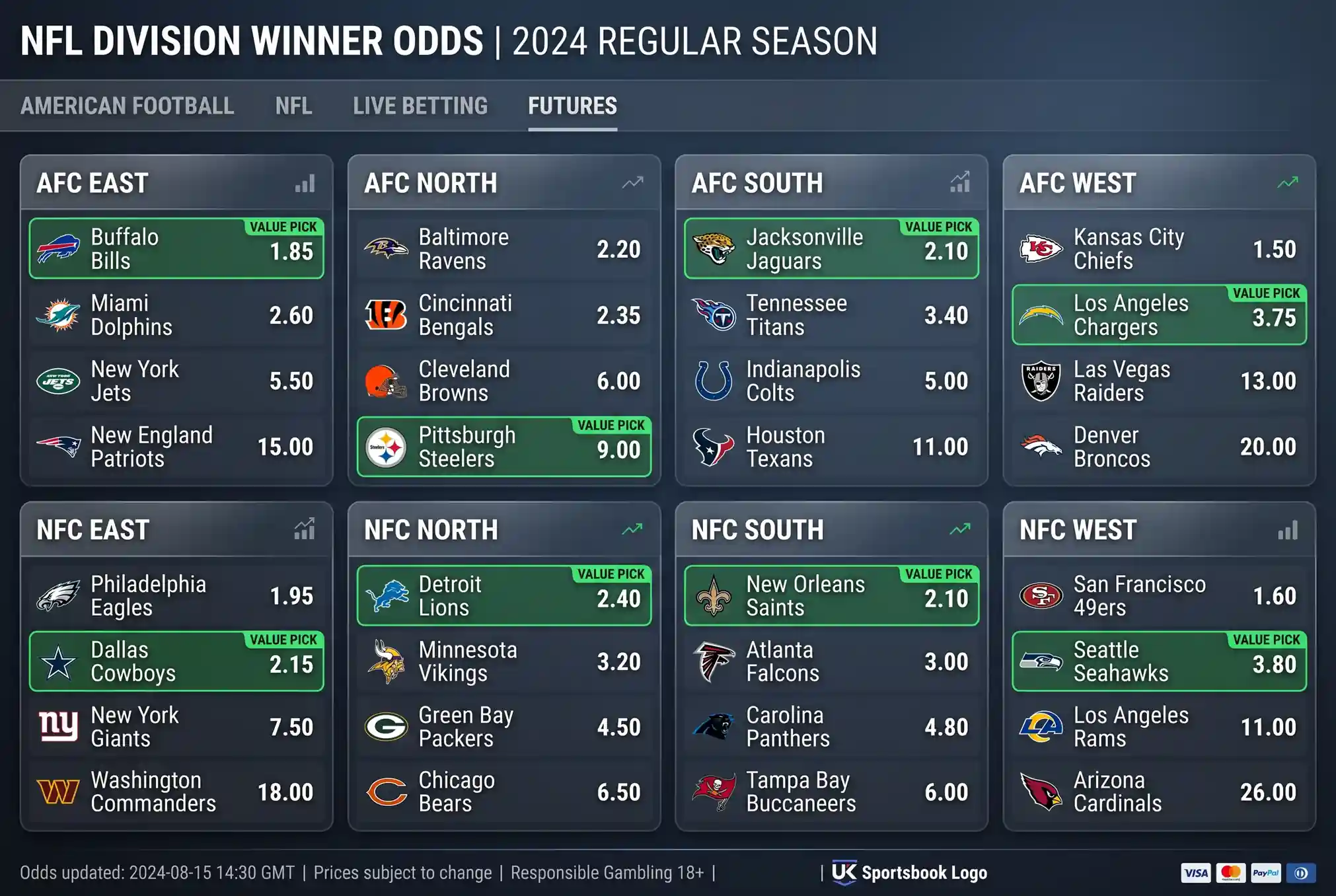
The division winner market is one of the most underrated NFL betting formats for UK punters, and it’s systematically underused. Most people jump straight to Super Bowl outrights or single-game spread betting – which makes sense given those are the headline markets at UK sportsbooks. Division winners occupy a middle ground that actually suits a specific type of analytical approach quite well: the timeframe is long enough to benefit from genuine predictive research, the field is small enough (four teams per division) to allow complete analysis, and the variance is manageable enough that the best-positioned team wins the division more often than not. The challenge is finding the windows when that best-positioned team is mispriced.
NFL Division Structure and Betting Relevance
The NFL’s 32 teams are divided into eight divisions of four teams each – four divisions per conference (NFC and AFC). Each team plays six of its 17 regular-season games against divisional opponents, which means divisional matchups make up roughly a third of each team’s schedule. Division winners receive guaranteed playoff berths, seeding advantages, and in some years, the difference between hosting a playoff game and being an away seed with a comparable record. The practical stakes of winning a division are significant beyond the cosmetic.
For betting purposes, the division structure creates two relevant dynamics. First: teams in the same division have well-documented head-to-head histories and mutual scouting advantages that reduce the information gap between them. Divisional games are consistently the most contested in the regular season schedule; upsets and competitive outcomes are more common in divisional matchups than in non-divisional games between teams of comparable ratings. Second: the concentrated competitive exposure within a division means roster injuries, coaching changes, or roster additions mid-season have exaggerated effects on divisional standings compared to non-divisional games, because the teams most likely to benefit from a competitor’s setback play them multiple times.
When to Bet Division Winners: Pre-Season, Mid-Season and Down the Stretch
The pre-season division market (May-August) is where the widest pricing inefficiencies typically exist, but also where the uncertainty is largest. The market at this stage is priced on projected roster quality, coaching staff assessments, and the previous season’s performance as a baseline. The gap between the market’s projection and actual season outcomes is largest here – which cuts both ways. Genuine pre-season analytical edges are available but the variance over a 17-game season against three motivated divisional opponents means even the correctly-identified best team loses their division a meaningful percentage of the time.
Mid-season division markets – available after Week 6 or 7, when the seasonal picture is developing – offer the best combination of information availability and residual variance. You have six weeks of actual performance data, injury reports, and genuine head-to-head divisional results to work from. The favourite has emerged based on reality rather than projection, but enough season remains that the odds haven’t fully collapsed to single-digit returns on the clear frontrunner. This is the window I’ve found most consistently productive for division betting over nine seasons of deliberate market tracking.
Late-season division markets (Week 12 onwards) are most useful for backing a team that’s opened a lead and needs only to avoid collapse – essentially a liability-hedge product. The odds reflect probability accurately at this stage, and the main analytical question is whether the leader’s remaining schedule contains genuine threats that the market has underweighted. Late-season divisional games carry elevated variance because both teams know the standings implications; a team fighting for their season beats a divisional leader with a comfortable cushion more often than the record gap would suggest.
The NFL Divisions That Produce the Most Competitive Betting Markets
Division competitiveness varies considerably between the eight divisions, and that variation directly affects the betting opportunity. Divisions with one clear structural favourite – typically built around a franchise quarterback under a long-term contract with a well-resourced organisation – produce markets where the pre-season price on the favourite is usually accurate and the value lies in correctly identifying when that favourite is genuinely vulnerable in a specific season. The AFC West (when multiple well-resourced franchises compete) and the NFC East (historically featuring volatile power shifts between franchises) have been among the most analytically interesting UK betting markets in recent seasons.
Divisions undergoing rebuild transitions – where a dominant team from the prior cycle has aged out of a championship window and a replacement challenger is emerging – tend to produce the most mispriced markets. The market anchors to recent history; the team that was dominant three seasons ago still receives pricing credit from casual bettors even after their competitive window has demonstrably closed. That anchoring creates systematic mispricing that analytical bettors can exploit if they correctly identify which point in the cycle each franchise actually occupies.
The NFC North and NFC South have historically alternated between single-dominant and genuinely contested formats on approximately three-to-four season cycles, creating good examples of the transition mispricing dynamic. In years when a historically dominant team is in clear decline and a challenger team has assembled the key components for a title run, the market persistently underprices the challenger through at least the first half of that challenger’s first competitive season.
How to Research NFL Division Markets: Strength of Schedule and Key Matchups
The most useful single input for division winner analysis is divisional strength of schedule – not overall schedule difficulty, but specifically the six games each team plays within their division. A team with the best overall roster in their division is still vulnerable to losing the division title if they face both divisional road games in the same two-week stretch mid-season, or if their divisional opponents are historically strong in the specific matchup types that expose this team’s weaknesses.
Head-to-head trend data within divisions is a legitimate analytical input that the weekly public betting market often ignores. Some offensive systems are structurally better at exploiting specific defensive schemes – and divisional opponents have had years to study and partially counter those advantages. A quarterback who produces excellent overall numbers against the league faces different challenges against divisional defensive coordinators who have studied six-plus games of film against them and installed specific coverage concepts designed to create problems for their tendencies. Knowing which divisional matchups are structurally difficult for each team, beyond simple win-loss records, improves division winner assessment.
Free agency timing relative to market opening creates a recurring analytical opportunity. Division winner markets typically open in March alongside free agency, but the significant free agency moves often happen in the first week of March before the official new league year begins on 15 March. Teams that make major additions in this window – particularly at quarterback or in defensive scheme positions that affect all divisional matchups – can be priced in pre-agency markets that don’t yet reflect the changed roster. Checking the market a full week after the free agency signing period opens, when the major moves have been made but some bookmakers haven’t fully repriced, is a consistently productive habit. For a complete overview of all NFL futures markets available at UK sportsbooks, the guide to NFL betting odds covers how futures pricing works and where the long-term market opportunities sit.
Frequently Asked Questions
When do UK bookmakers open NFL division winner markets for the season?
UK bookmakers typically open NFL division winner markets in late January or February, shortly after the Super Bowl, as futures markets for the next season. The initial prices are based on projected rosters and the previous season’s performance. Markets reprice significantly in March and April as the free agency period and NFL Draft add new information. The most liquid pre-season period for division betting is May through August, when training camp reports and preseason results add further price movement.
Is there still value in division winner bets after Week 6 of the NFL season?
Yes, mid-season division markets (roughly Week 6-10) can offer good value when a genuine contender has underperformed early due to injury or schedule difficulty but retains strong structural fundamentals for the remainder of the season. The key is identifying whether early-season underperformance reflects temporary factors (injury, tough schedule) or genuine capability decline. A team at 2-4 due to a brutally difficult early schedule with a manageable divisional run-in may be meaningfully underpriced at that record compared to their actual remaining probability.
How many teams from each division make the NFL playoffs?
One team per division wins the division and receives a guaranteed playoff berth and a top-4 seed in their conference. Beyond division winners, three additional wild card teams per conference also qualify – the three teams with the best records among non-division-winners in each conference. This means the total playoff field is 14 teams across both conferences (7 per conference: 4 division winners plus 3 wild cards). Division winners always receive higher seeds than wild card teams with equivalent or better records.
Written by the editors at nfl Games Betting.