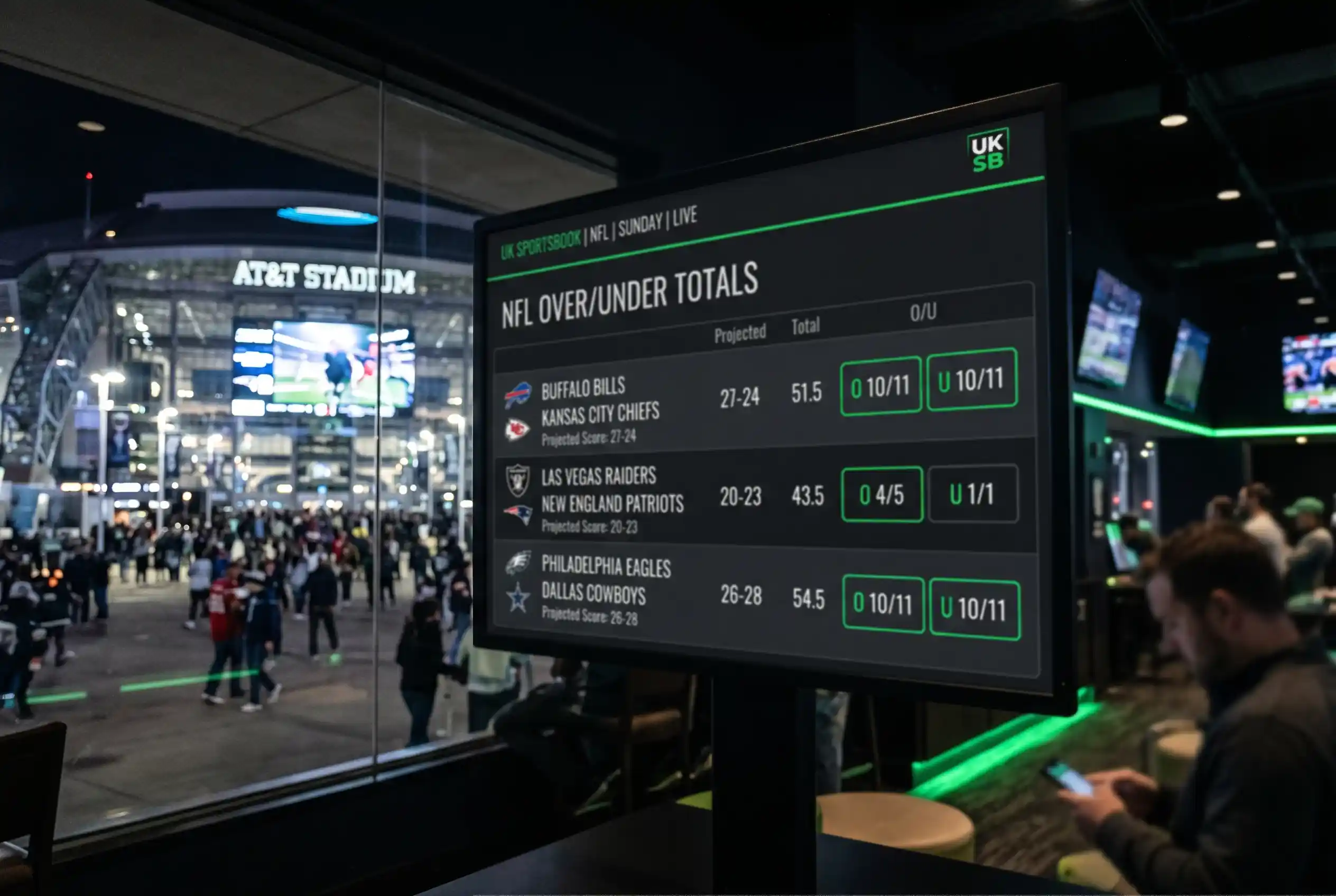
UK NFL Week 1 Betting: Opening Fixtures and Underdogs
 Available in US
There is no week in the NFL calendar quite like Week 1. Not because of the spectacle – though that’s real – but because of the specific information environment that exists before a single regular-season snap has been played. Pre-season results are misleading by design (starters barely play), off-season rosters are theoretical until tested, and the bookmaker’s line is built almost entirely on the previous season’s data plus summer speculation. That combination creates a uniquely exploitable environment that I look forward to every year precisely because of its unusual analytical properties. The patterns that hold in Week 1 don’t necessarily hold in Week 8, and understanding why is the starting point for using the opening fixture intelligently.
Specifics of NFL Week 1 Betting Markets
The fundamental reason Week 1 is different: the bookmaker’s spread is calibrated on a team’s projected quality based on last season’s performance and off-season moves, but both teams enter the game without a single regular-season data point from the current year. The line is essentially a historical estimate with an uncertainty premium baked in.
For established, predictable teams – those that have been consistently good or consistently bad for multiple years – the spread is reasonably grounded. For teams in transition (new head coach, significant off-season acquisitions or losses, key injuries resolved during pre-season), the spread is a cruder approximation. Transitional situations create the widest gap between the bookmaker’s estimate and the actual game-day reality – and those gaps are where value hides.
The other structural feature of Week 1 is preparation time. Unlike a mid-season game where both teams have film on several recent opponents, Week 1 teams are preparing for each other based on the previous season’s tape and whatever they’ve picked up from pre-season. Coordinators who are known for disguising schemes – who look different week to week, who install wrinkles the opponent hasn’t seen – have maximum impact in Week 1 before their tendencies are established on current-year film. This is a qualitative factor that’s hard to quantify but directionally real.
Week 1 Underdog Trends: Historical Data on Spread Coverage
The historical record on Week 1 underdogs is clear and worth internalising: since 2000, underdogs in Week 1 games have covered the spread at a profitable rate above 53%. That’s not a fluke. It reflects structural factors that are predictable rather than random.
The core logic is simple: the spread in Week 1 leans heavily on the previous year’s data. Teams that overperformed last season (often due to fluky variance – turnovers, special teams, late-game luck) are priced as favourites based on that record, even though regression to the mean is predictable. Teams that underperformed last season (for reasons that may have been temporary) are priced as underdogs even if their underlying talent and the corrective factors are in place. The bookmaker and the public both anchor to last year’s records in Week 1, and the market is systematically slow to update.
The effect is real, but the application requires care. A 53% cover rate for underdogs in aggregate doesn’t mean every Week 1 underdog is a profitable bet. It means the cohort has historically outperformed the spread pricing – some significantly, some not at all. The correct application is to use this base rate as a prior that increases your interest in Week 1 underdog positions when other factors also point in that direction: a transitional situation at the favourite, a specific matchup advantage for the underdog, a line that has moved further toward the favourite due to public money.
Divisional Matchups in Week 1: A Market That Favours the Underdog
The underdog effect in Week 1 intensifies dramatically in divisional matchups. Divisional underdogs in Week 1 have covered the spread at a historically exceptional rate – the documented pattern from long-run data suggests cover rates well above 60%, which is an extraordinary figure in a market that’s trying to price at 50%.
The mechanism is the familiarity advantage I mentioned earlier. In a divisional game, both teams have played each other at least twice per season for years. The schemes are known, the tendencies are documented, the individual player matchups are familiar. The spread is set on talent differential, but the game plays out on the compressed version of that differential that emerges when both coaching staffs are intimately familiar with each other’s systems. The underdog’s defence knows the favourite’s offensive tendencies. The underdog’s coordinator has a specific game plan built around disrupting the opponent’s known tendencies. That tactical familiarity is worth points – and it’s worth more in Week 1 than later in the season because the current-year wrinkles that would defeat that familiarity haven’t been installed yet.
This is the kind of structured edge that makes Week 1 divisional underdog situations genuinely interesting to evaluate each August. The situation doesn’t guarantee a cover – nothing does in NFL betting – but it provides a meaningful statistical prior that, when combined with favourable matchup factors, produces a higher expected value than the line reflects.
UK Bookmaker Promotions for NFL Week 1
UK bookmakers consistently use the NFL season opener as a promotional trigger. Welcome offers are activated for new customers in August to capture the Wave of interest at season start. Existing customers typically see enhanced odds on featured Week 1 games, accumulator insurance on opening-weekend parlays, and price boosts on specific high-profile matchups. The Thursday night opener – which has become a flagship Week 1 event – attracts specific promotion activity at most major UK platforms.
For UK punters opening their first NFL betting accounts, timing this around Week 1 is rational: you access the promotional welcome offer at the moment when the first batch of genuinely interesting spread markets becomes available. The Thursday and Monday games flanking the main Sunday slate mean you have early opportunities to use welcome offer qualifying bets before the main weekend card. To understand how to apply the situational strategy from this piece to the full season, the NFL betting strategy UK guide covers bankroll structure, line shopping, and situational betting frameworks that carry these Week 1 principles through the rest of the calendar.
Frequently Asked Questions
Are preseason results a reliable predictor for NFL Week 1 betting?
No. NFL preseason results have no meaningful predictive value for Week 1 regular-season games. Starters typically play one quarter or fewer in preseason games, meaning the results are driven by second and third-string players whose regular-season roles are limited. Bookmakers and sharp bettors both largely ignore preseason records when setting and moving lines. The only relevant information from the preseason period is injury developments to key starters – particularly quarterbacks – which do directly affect Week 1 lines.
Do UK bookmakers offer enhanced odds for NFL opening weekend?
Yes, most major UK bookmakers run enhanced odds promotions specifically for NFL opening weekend. The Thursday night season opener typically attracts a featured price boost or enhanced accumulator offer. The main Sunday card often sees platform-specific boosted prices on key matchups. New customer welcome offers are also deliberately timed to activate around the season opener – most UK bookmakers run their NFL-specific new customer promotions from late August through the first two weeks of the regular season.
How far in advance can I bet on Week 1 NFL games at UK sportsbooks?
UK bookmakers typically open Week 1 NFL markets 5-7 days before the first game, which means lines for the Thursday opener become available on the preceding Friday or Saturday. Some platforms open selected Week 1 markets further in advance – up to two weeks before the season starts – particularly for the marquee Thursday night opener. Pre-season outright and Super Bowl futures markets are available months in advance and are not subject to the same opening timeline as individual game markets.
Published by the nfl Games Betting team.