UK NFL In-Play Betting Tips: Live Wagering Windows
 Available in US
Knowing how NFL in-play betting works is one thing. Knowing when to act, which markets to target at which moments, and which instincts to override is something else entirely. I’ve spent nine seasons tracking my own in-play NFL bets at UK sportsbooks and the single clearest finding is this: the bettors who treat live wagering as a series of tactical decisions outperform those who treat it as a continuous reaction to the scoreboard. The odds engine is faster than you, the data feed is more complete than your TV picture, and the bookmaker’s margin is baked into every price. What you bring to the table is contextual game reading, disciplined timing, and the ability to identify the specific moments where the live market hasn’t fully adjusted to what’s actually happening on the field.
Quarter-by-Quarter NFL In-Play Betting Opportunities
The first quarter is primarily an information-gathering period rather than a betting window. The live spread at this stage reflects a blend of the pre-game line and early scoring, but the game’s actual shape — which offensive scheme is working, whether a defensive coordinator’s plan is holding up, how the run-pass balance is developing — takes at least one full possession cycle per team to become readable. Placing in-play bets in the first ten minutes of game time is reacting to surface-level scoring events without the context to assess whether they represent the game’s likely trajectory. The exception is a clear observable factor that the market hasn’t priced: a visible injury to a key player that hasn’t yet been confirmed by the broadcast, or a scheme mismatch that’s producing consistent yardage without generating points.
The late first quarter through the middle of the second quarter is where my highest-conviction in-play windows sit. By this point you have real offensive and defensive data from both teams, the initial game plan adjustments are visible, and the live spread has moved from its pre-game anchor but hasn’t yet fully incorporated the emerging game narrative. A team whose offensive line is winning at the point of attack consistently but whose drives have stalled on two red-zone turnovers is a different proposition from a team that’s been comprehensively outplayed — but the live spread may not fully distinguish between these situations if the score is similar.
The two-minute warning in each half creates specific tactical states that generate in-play value. Teams trailing at the two-minute warning in the second quarter are forced into tempo changes and aggressive play-calling that the live total doesn’t always price accurately. The live total at this point typically reflects remaining mathematical scoring potential based on time and historical averages — but a team running a hurry-up offence against a prevent defence generates scoring opportunities at a rate well above historical averages for the remaining clock time.
The opening drive of the second half is undervalued by the live market more consistently than any other single game moment I’ve tracked. Coaching staffs with strong halftime adjustment records — and this is a trackable, historical data point — produce measurably different second-half offensive outputs compared to their first-half performance. The live market at halftime prices the second half based on aggregate game state; it does not differentially weight the quality of the specific coaching staff’s adjustment history. That gap between aggregate pricing and specific coaching context is a repeatable analytical edge.
Which In-Play Markets to Target and Which to Avoid
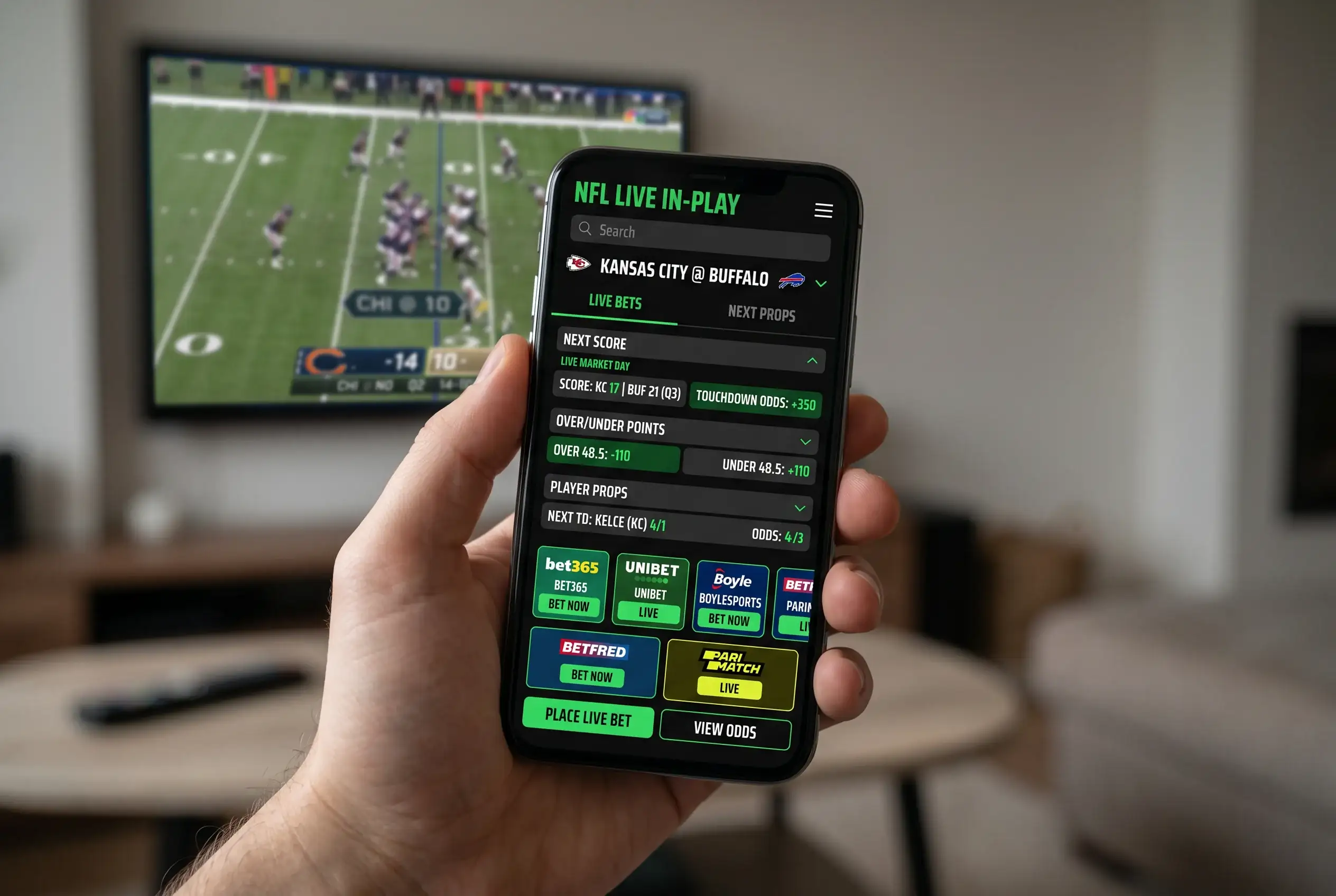
The next-score market is the single most analytically rewarding live NFL market at UK sportsbooks, and it’s also the one that most casual in-play bettors ignore in favour of the live spread or moneyline. The next-score market isolates a short-term outcome — which team scores next, by what method, or whether no score occurs before a defined event — in a way that rewards real-time game-context reading. The bookmaker prices next-score using base rates adjusted for field position and game state; what the model handles less well is qualitative drive-quality assessment. A team on their own 20-yard line after a three-and-out is priced differently from a team on their own 20 after a turnover, but the model may not fully account for the momentum and scheme-disruption effects of that turnover on the next drive’s likely outcome.
Live totals are worth targeting specifically in games where pace has diverged from pre-game expectations. A game that opened at 47.5 and sits at a live total of 43.5 in the third quarter with both offences running efficient, methodical drives creates a specific analytical question: is the remaining scoring potential being generated in a way consistent with further scoring? High-efficiency drives that are consuming clock through successful rushing produce different residual total dynamics than high-efficiency passing attacks that are scoring quickly. The live total reflects remaining time-based scoring expectation; the analysis requires understanding how that time is being consumed.
The live moneyline is the market I’d steer newer in-play bettors away from most firmly. It’s the most liquid, most efficiently priced, and most margin-loaded in-play market at UK bookmakers. The apparent value in backing a trailing team at long odds is almost always an illusion — the bookmaker’s implied probability for a comeback is accurate because it’s derived from the same comprehensive dataset that produced the pre-game line, updated with real-time game state. The dramatic comeback scenarios that make the long-odds moneyline look tempting happen at almost exactly the frequency the odds imply. There is no systematic value in the live moneyline unless you have a specific, identifiable informational edge that the market hasn’t incorporated — and if you’re watching on Sky Sports with a several-second broadcast delay, you almost certainly don’t.
Common In-Play Betting Mistakes and How to Avoid Them
The most expensive mistake in NFL in-play betting at UK sportsbooks is confusing emotional conviction with analytical conviction. When a team you’ve backed pre-game falls behind and you feel the urge to double down in-play because you “know” they’ll come back, that’s emotional conviction. Analytical conviction comes from identifying a specific, articulable reason why the live market is mispricing the current game state. The difference between these two states is the difference between in-play betting as a strategic tool and in-play betting as an accelerated way to lose money.
Chasing losses through in-play betting is structurally easier than chasing through pre-game betting because the opportunity to bet again is constantly present. The 40-second play clock means a new market window opens roughly every minute of real time during an NFL broadcast. For UK punters watching late-evening games when fatigue compounds the emotional pressure of a losing position, the temptation to keep firing is both more intense and more dangerous. Set a session stake limit before the game starts — a fixed amount you’re willing to commit to in-play markets for that game — and close the app when it’s reached, regardless of the game state.
Over-betting the first half is a pattern I see consistently in my own historical data and hear reflected by other serious NFL bettors. The first half feels like where the information is most fresh and the analytical edge is strongest, but the reality is that the second half typically offers better-structured opportunities because of halftime adjustments, fatigue effects, and the increasing predictability of game management decisions as the clock runs down. Distributing your in-play stake allocation across the full game rather than front-loading it into the first and second quarters produces more consistent outcomes over a season-length sample. NFL betting strategy for UK punters covers bankroll management and session structure in more detail for those building a systematic in-play approach.
Frequently Asked Questions
What is the best time to place an NFL in-play bet at UK sportsbooks?
The highest-value timing windows are typically the late first quarter through mid-second quarter, when real game data has emerged but the live market hasn’t fully adjusted from its pre-game anchor, and the opening drive of the second half, when coaching adjustments create predictable performance shifts that the live line doesn’t differentially price. The two-minute warning in both halves also creates specific tactical states worth assessing. Avoid betting in the first ten minutes unless you’ve identified a clear factor the market hasn’t priced.
Should I use cash out on my NFL in-play bets?
Cash out is genuinely useful when new information has materially changed the expected value of your position — for example, if a key player has been injured since you placed the bet. Where cash out typically destroys value is in taking partial profit mid-game when the game is developing in line with your original analysis. The cash-out price includes bookmaker margin, so the implied probability is systematically worse than the true current win probability of your bet. Unless new information has invalidated your original reasoning, letting the bet run is mathematically superior in most cases.
Which NFL in-play market is easiest for beginners at UK bookmakers?
The live spread is the most accessible starting point because it follows the same logic as the pre-game spread with adjusted numbers reflecting the current score and game state. Begin with single in-play spread bets on games you’ve watched from the opening kick-off so you have full context. Avoid the live moneyline initially — it looks attractive when teams are trailing but is the most efficiently priced in-play market with the highest built-in margin.
Written by the editors at nfl Games Betting.