UK NFL Handicap Betting: Point Spread Lines
 Available in US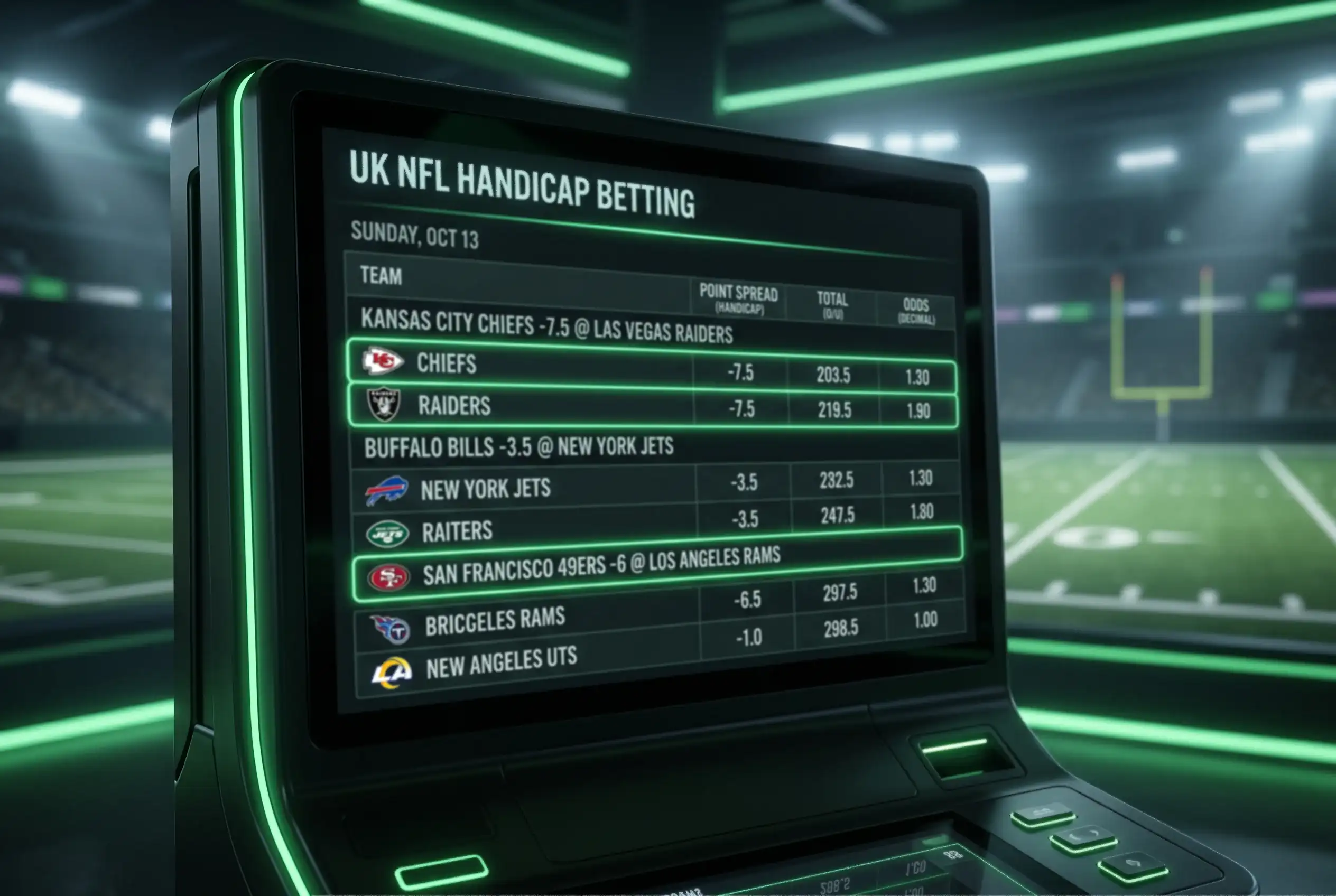
If you’ve only ever bet on Premier League football, handicap betting feels comfortable enough – you’ve seen -1, +2, Asian lines. NFL spread betting is built on the same idea but executed quite differently in practice. The numbers are bigger, the half-points matter more, and the market is driven by a pricing ecosystem that operates mostly on the other side of the Atlantic. I’ve been working with NFL spreads for nine years and the spread market remains, in my view, the most interesting and exploitable market UK bookmakers offer on American football. Here’s how it actually works.
NFL Handicap Point Spread Basics
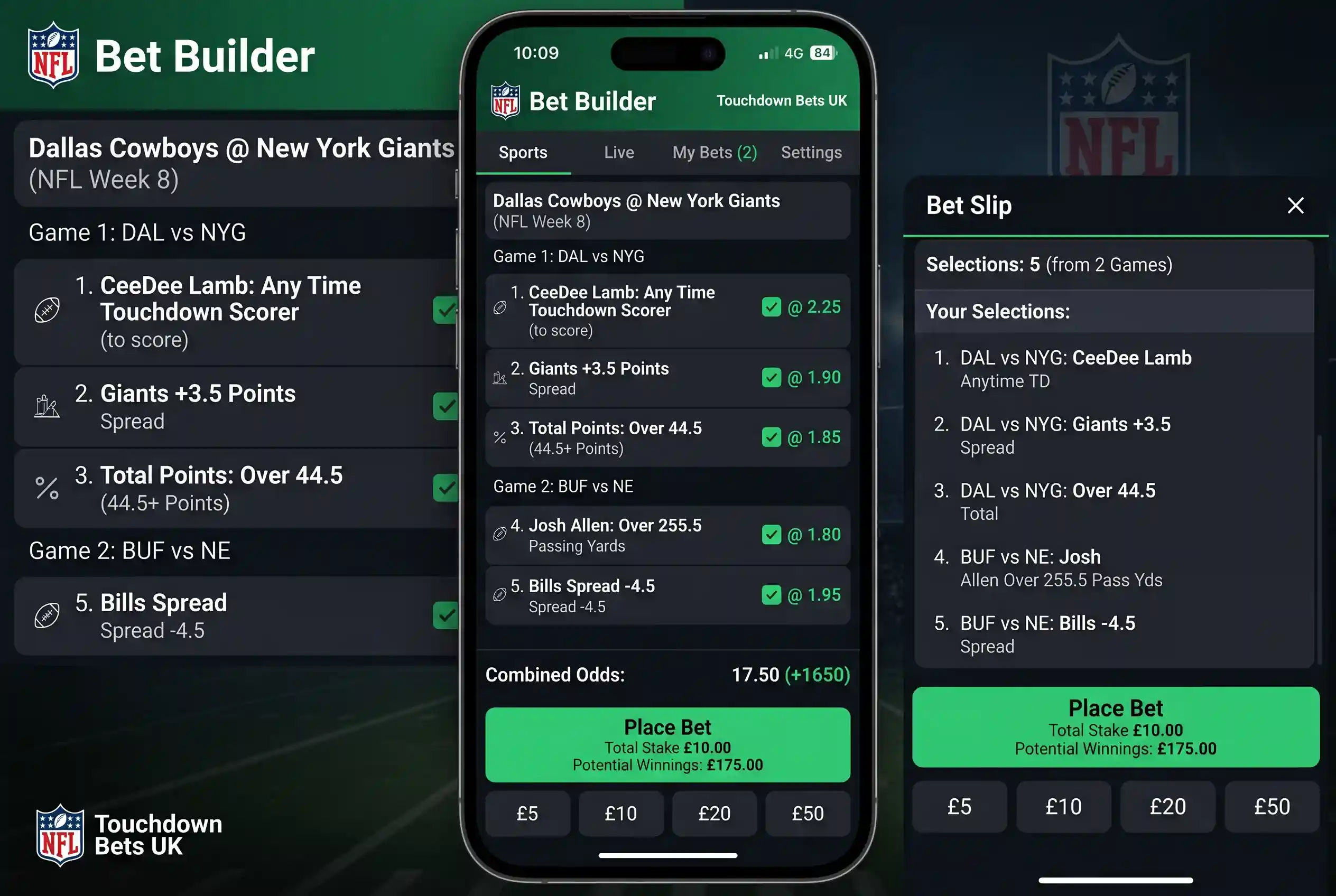
The NFL spread – also called the “line” or “handicap” – is a points advantage given to the underdog before the game starts, designed to make both sides approximately equally attractive to bet. A line of “Bills -7” means Buffalo are favoured by 7 points. Bet on the Bills and they need to win by 8 or more for you to win. Bet on the opponent at “+7” and you win if that team either wins outright or loses by 6 or fewer.
The key difference from football handicaps is the margin of victory in the NFL. Scores in American football move in chunks – touchdowns worth 6 or 7 points, field goals worth 3 – so spreads cluster around specific numbers that reflect these natural scoring units. The most significant numbers are 3 and 7. A 3-point spread is the equivalent of one field goal; a 7-point spread is exactly one converted touchdown. When a line sits at 3 or 7, it’s sitting at its most significant position. Moving from 3 to 3.5 changes the outcome of a notable proportion of NFL games because a 3-point final margin is so common. Experienced bettors pay close attention to which side of these key numbers a line sits on.
Settlement at UK bookmakers is typically straightforward: if the favourite wins by exactly the spread amount (say, Bills -7 and they win by exactly 7), the bet is a “push” and your stake is returned. Half-point spreads (-7.5, +3.5) eliminate the push entirely – oddsmakers use them deliberately to avoid this. Most UK platforms settle spread bets without the push option by defaulting to half-point lines on the main markets.
How UK Bookmakers Set the NFL Point Spread
Bookmakers don’t conjure spreads from thin air. The opening line on any NFL game originates from professional oddsmaking operations – primarily the large US wholesale market – and UK bookmakers typically open their own lines close to those consensus figures, then adjust based on the betting action they receive.
The spread is set to represent the expected margin of victory, adjusted for market dynamics. A team that is genuinely 10 points better than their opponent won’t necessarily open at -10 – the bookmaker also considers which side the public will back heavily, because a spread that attracts entirely lopsided action is a liability, not a business. Popular teams (and in the UK market, Kansas City sit at the extreme end of this – accounting for nearly a tenth of all NFL-related searches in Britain) attract public money regardless of objective probability, so their spread is often shaded slightly to account for the influx.
Power ratings underpin the calculation. Oddsmakers maintain continuous team ratings based on scoring differentials, opponent adjustments, home-field advantage (typically worth 2.5-3 points in the NFL), and situational factors. The line that comes out of that model is then tested against the market. UK bookmakers don’t all price independently – smaller operators frequently copy or shade lines from larger competitors, which means the UK market for NFL spreads is reasonably efficient but not perfectly so.
Using ATS (Against the Spread) Records to Find Value
ATS stands for “against the spread” – a team’s record of covering or failing to cover the point spread, as opposed to their straight-up win-loss record. It’s one of the most commonly cited stats in NFL betting analysis, and also one of the most frequently misused.
The correct use of ATS records is as a filter, not a conclusion. A team that has covered in 7 of their last 10 games sounds compelling. But if those 10 games were all against weak opponents, or the line was consistently set too high against them, the ATS record is a reflection of market mispricing – and once that mispricing gets noticed, it corrects. Historical ATS data is valuable when it reveals consistent situational patterns across larger sample sizes and controlled circumstances, not when it’s applied as raw recent form.
The more interesting ATS application is situational: specific game contexts that have historically produced spread cover rates significantly above 50%. One documented trend worth noting: since 2000, underdogs in Week 1 games have covered the spread at a profitable rate above 53% – and when those underdogs are divisional opponents of the favourite in Week 1, the cover rate climbs substantially higher. That’s not a betting system on its own, but it’s the kind of structured edge that deserves attention when the situation arises and the price is right.
UK punters using ATS data should access it from reputable statistical databases rather than betting tipster sites. The data itself is neutral; the editorial framing around it often isn’t. Build your own simple spreadsheet tracking the specific situations you find interesting and evaluate them over a multi-season sample before acting on them.
Common Mistakes UK Punters Make on NFL Handicap Bets
Nine years of watching UK bettors approach NFL spreads has produced a fairly consistent list of recurring errors. None of these are unique to British punters – but the NFL is a sport most UK bettors know less deeply than football, and that knowledge gap amplifies each mistake.
The first and most damaging: betting the spread based on who you think wins the game. A spread bet is not a prediction of the winner. A team can lose by 2 touchdowns and your spread bet on them still wins. If you’re evaluating spread bets by running through who you think is the better team, you’re solving the wrong problem. The question is whether the favourite is genuinely good enough to beat the spread, not whether they’re going to win.
The second: ignoring injury reports. Unlike Premier League football, NFL injury reporting is highly formalised and publicly available throughout the week. Players are officially listed as Questionable, Doubtful, or Out on official injury reports released on Wednesday, Thursday and Friday. A key starting quarterback listed as Questionable on a Friday can see the spread move by 3-4 points by kickoff depending on his final status. Betting without checking the Friday injury report is leaving significant information on the table.
The third: chasing bad lines. UK bookmakers on NFL don’t all price simultaneously – some open earlier in the week, some are slow to react to US market movement. If a line that opened at -3 is now at -5.5 at every major platform, the moment for that bet has passed. Forcing a wager at a worse price because you’d already mentally committed is a common and costly habit. If you want to understand how the different types of spread bets interact with the broader NFL betting market, the overview at NFL bet types for UK punters covers the full picture.
Frequently Asked Questions
What is a pick’em game in NFL spread betting and how is it priced?
A pick’em (sometimes written PK) is a game where the point spread is zero – neither team is favoured. Both sides are treated as equally matched, so both moneyline prices will be similar and the spread market offers both teams at roughly the same odds (typically around 1.87-1.91). Pick’em games are uncommon but occur several times per NFL season, usually between closely matched teams in the same conference.
Can I bet on NFL handicap markets in-play at UK bookmakers?
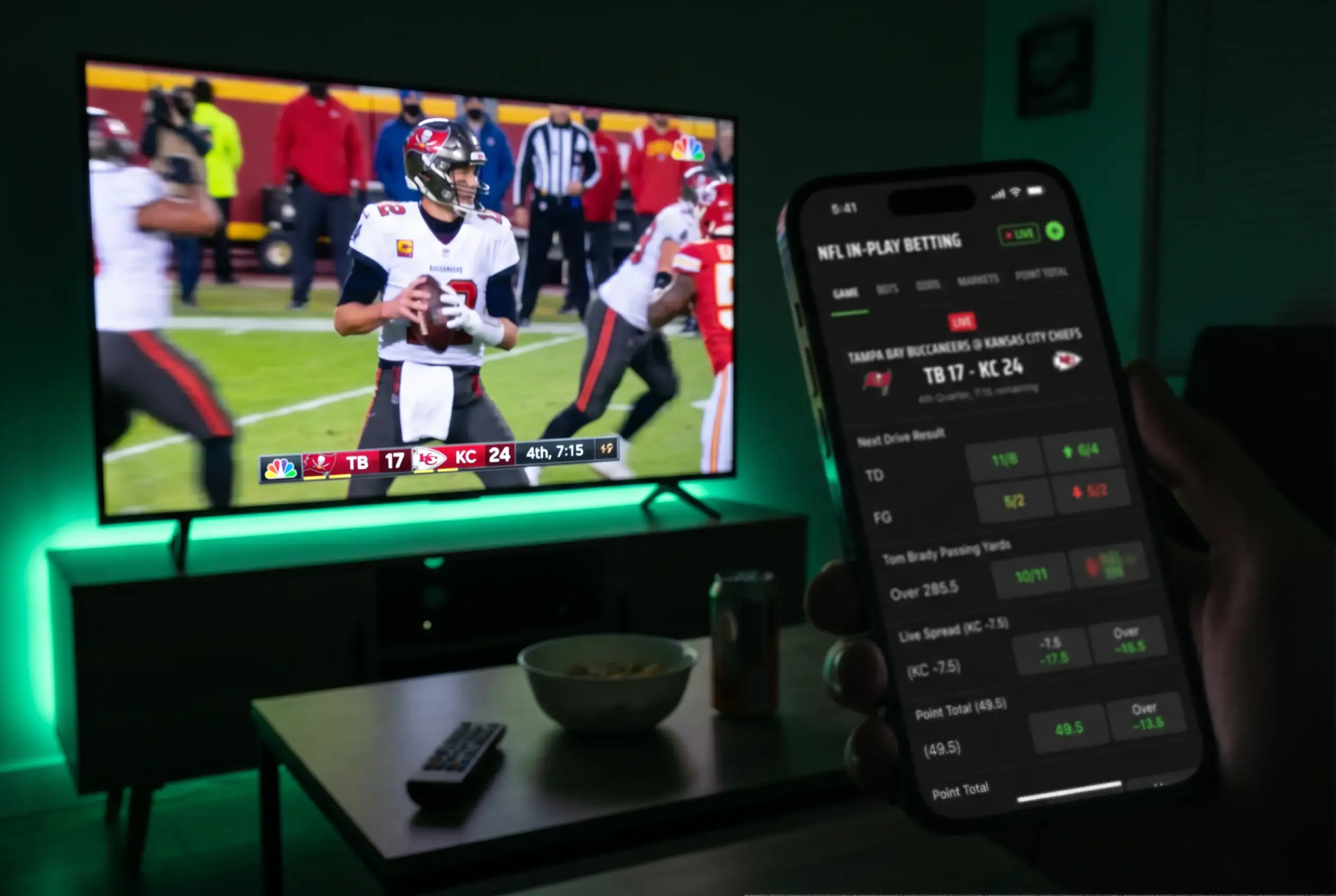
Yes, most major UK bookmakers offer live NFL spread betting, though the markets are suspended during active plays and only available between downs or at breaks. In-play spread lines move quickly and the margins tend to be slightly wider than pre-match. The bookmaker reprices continuously based on score, down-and-distance, field position, and game clock – making in-play spread bets significantly more complex to evaluate than pre-match lines.
How is a push (tie) on an NFL spread bet settled in the UK?
A push occurs when the final margin equals the spread exactly – for example, backing -7 and the favourite wins by exactly 7. UK bookmakers typically refund your stake in full on a push, treating it as a void bet. To avoid pushes on the main spread market, many bookmakers use half-point lines (-6.5, -7.5) by default. If you’re offered a whole-number spread, check the bookmaker’s push settlement rules before placing.
Prepared by the nfl Games Betting editorial staff.