UK NFL Over/Under Betting: Point Totals and Markets
 Available in US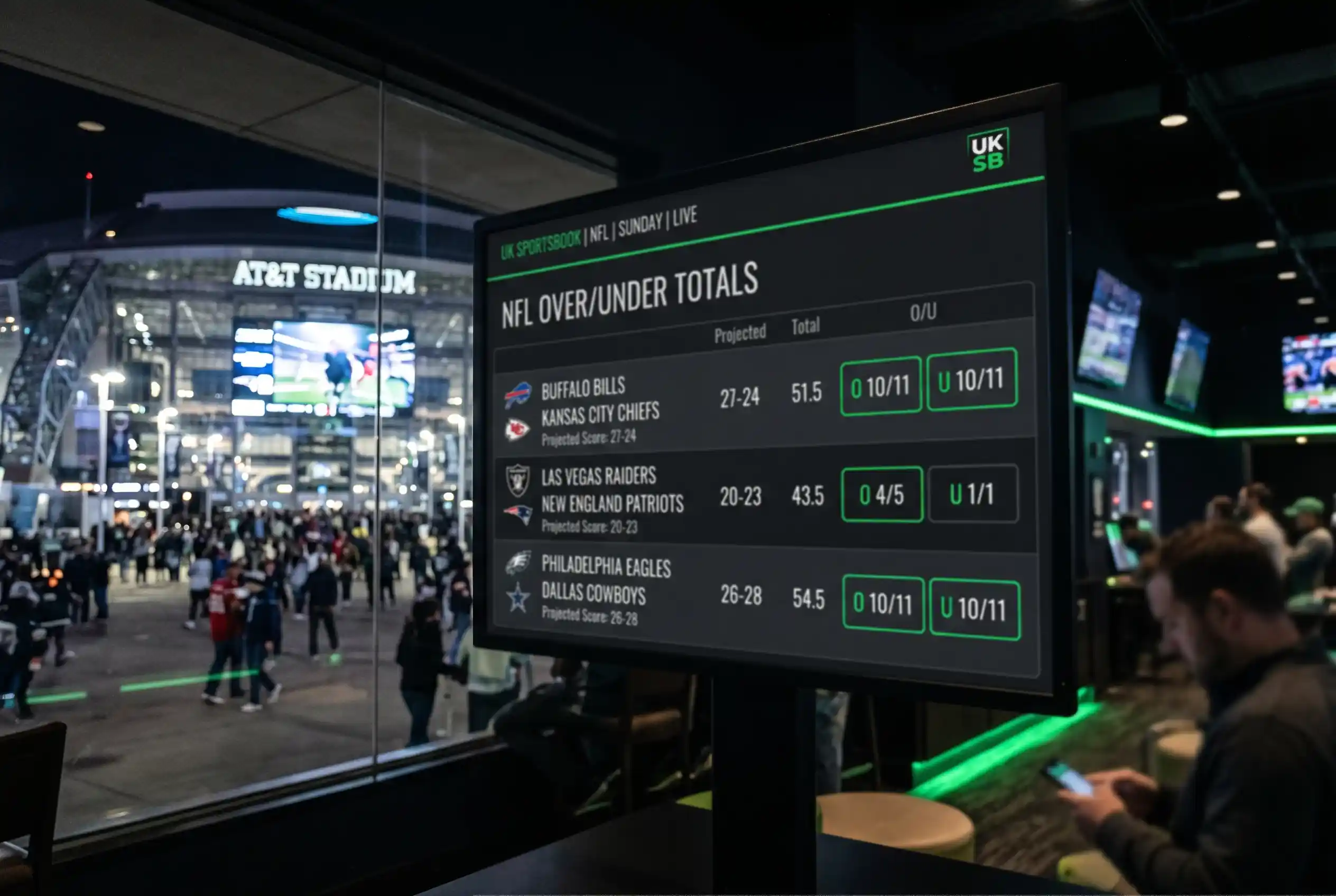
During the 2024 NFL season, favourites won outright in more than 71% of regular-season games – the third-highest rate since 1980. That dominance made certain weeks brutal for anyone betting spreads. But here’s what rarely gets discussed in those post-mortems: the totals market can be insulated from that dynamic entirely. Over/under bets don’t care who wins. They care about how many points end up on the scoreboard, and that’s a question shaped by completely different forces. I’ve spent a meaningful portion of my nine years on NFL markets in the totals space precisely because it rewards a different kind of analysis from what most punters are doing.
NFL Totals Betting Mechanics for UK Sportsbooks
The total is the bookmaker’s projected combined score for both teams in a game. If a game is set at 44.5, you’re betting on whether the two teams will combine for 45 or more points (over) or 44 or fewer (under). That’s it – the identity of the winning team is irrelevant.
UK bookmakers price totals markets similarly to the spread: both sides at roughly 1.87-1.91 in decimal odds, with the half-point built in to eliminate pushes. The standard overround is comparable to the spread market, making NFL totals one of the lower-margin sports betting markets available through UKGC-licensed platforms.
One practical point for UK bettors specifically: the totals on NFL games are denominated in American football scoring units, not football match scores. A total of 44.5 is a moderate-to-high projected score for a single NFL game – roughly 22-23 points per team. Totals across the league in a given week typically range from the high 30s for defensive-heavy matchups to the mid-50s for offensive showdowns. Context matters when you’re assessing whether a number looks high or low.
Settlement is straightforward. Your bet is settled on the final score at the end of regulation plus any overtime. If a game goes to overtime and the score crosses your total threshold during that period, your over bet wins. Overtime is included in settlement unless the bookmaker has specifically offered a “regulation time only” market, which is less common for totals than for spread bets.
Key Factors That Affect NFL Game Totals: Weather, Pace, and Injuries
A high-scoring game doesn’t happen by accident. Four variables drive NFL scoring in ways that are quantifiable and – crucially – partially predictable before a game starts.
Weather is the most dramatic and most underused by UK punters. An outdoor game in Buffalo or Green Bay in November, with sustained winds above 15mph, is a fundamentally different proposition from a dome game in Las Vegas. Strong crosswinds affect passing accuracy and field goal range. Cold temperatures and precipitation slow the pace of play and reduce the accuracy of deep routes. Research consistently shows that games played in severe weather conditions produce fewer total points – and yet totals lines on weather-affected games don’t always fully price that in, particularly when one team in the matchup plays a run-heavy offensive style that is less weather-sensitive. The betting market in the UK tends to be behind US sharp markets on weather adjustments. If you can check the forecast for late-afternoon Sunday games in the northeast or midwest before placing your totals bet, you have access to information that is relevant and not always reflected in the line.
Pace of play is a structural factor. Teams that run more plays per game create more scoring opportunities for both sides. The league-wide pace has generally trended upward over the past decade as no-huddle and up-tempo offences have proliferated. Matchups between two fast-paced teams raise the projected total; matchups between defensive-oriented, time-of-possession-focused teams lower it. Offensive and defensive efficiency ratings – points per drive, yards per play – are publicly available and worth consulting before betting totals.
Injury reports hit totals most directly at the quarterback position. A starter replaced by a backup doesn’t just reduce that team’s offensive output – it changes the entire game plan, typically toward more conservative play-calling and lower projected total points. A key offensive lineman injury is less visible but can be equally significant: pressure on the quarterback reduces pass attempts, rushing yards, and total scoring.
First-Half and Quarter Totals: More Specific NFL Markets
Beyond the full-game total, most UK bookmakers now offer first-half totals and, on selected games, individual quarter totals. These are genuine analytical opportunities for punters who are willing to dig deeper than the headline number.
First-half totals typically sit at roughly half the full-game total, give or take a point. But they’re not simply divided proportionally – bookmakers adjust for the fact that first halves and second halves have different scoring profiles. Teams that run the ball heavily tend to score more in the second half as the defence tires; teams that rely on quick-strike passing may see their efficiency decline as the game plan adjusts. If you have a view on a specific team’s first-half tendencies, first-half totals are a market worth pricing properly.
Quarter totals narrow the sample further, which means higher variance – but also means that specific tactical situations, such as teams starting games slowly or an aggressive offensive team that opens each half with fast drives, can be directly targeted rather than diluted across sixty minutes of game time.
How to Find Value in NFL Over/Under Markets
The framing I use when evaluating a totals market is simple: what would this game score if played ten times? The bookmaker’s total is their best estimate. My question is whether I have reasons to believe the true distribution of outcomes is meaningfully different.
Start with the base rate. The full-game total for a typical NFL game sits in the 43-47 range for most regular-season matchups. A total set at 51.5 is in the top tier of projected scoring – which is genuinely rare. Before betting over on a 51.5 total, ask yourself whether this specific matchup genuinely has structural reasons to produce exceptional scoring, or whether the line is a reaction to a recent high-scoring game by one team. “Recency bias” is the most consistent exploitable error in NFL totals markets – bookmakers adjust lines after outlier scoring performances in ways that overweight the last game’s outcome rather than the team’s true underlying tendency.
The under is statistically underbet by recreational punters – people enjoy betting on scoring because it aligns with what makes games enjoyable to watch. That systematic public bias toward the over means the under is often slightly better priced on popular matchups. I’ve found this effect most pronounced on divisional rivalry games between defensive teams, where the line gets inflated by general public enthusiasm, and on late-season games between teams with eliminated playoff chances whose motivation to score is genuinely lower. The key context about live and in-play betting growing to over 62% of the online sports betting market by share also matters here – recalibrating your totals position during a game based on first-half scoring pace is increasingly accessible through UK platforms.
Frequently Asked Questions
What happens to my NFL over/under bet if the game goes to overtime?
Overtime scoring counts toward your total. If you bet over 44.5 and the game is tied 21-21 at the end of regulation, any overtime scores are added to the total – so a field goal in OT would make the final score 24-21 for a combined 45, settling your over bet as a winner. UK bookmakers settle NFL totals on the full final score including overtime unless a specific regulation-only market is offered.
Do UK bookmakers offer player-specific over/under markets for NFL?
Yes – player totals (also called player props) are widely available at major UK bookmakers, covering passing yards, rushing yards, receiving yards and touchdowns for key players. These work identically to game totals: back over 74.5 receiving yards and the player needs 75 or more for your bet to win. The number of players covered varies by bookmaker and by game importance – Super Bowl and playoff games see far deeper prop menus than mid-season matchups.
Are NFL totals harder to beat than the spread at UK bookmakers?
Neither market is consistently easier to beat – they reward different types of analysis. The totals market is arguably less driven by public bias toward specific teams, since there’s no obvious ‘home team’ or popular side to back. This can make it slightly more efficient in some contexts. However, the weather, pace, and injury variables that affect scoring are harder to model than win probability, so the analytical workload is different rather than lighter. Both markets sit at comparable overround levels at UK bookmakers.
Published by the nfl Games Betting team.